
Choose a Hilo Record Before Searching
A useful Hilo residents directory is really a route through several official systems. Start with the fact already known: a street address belongs in the County parcel tools, a deed party belongs in the statewide Bureau of Conveyances, a court party belongs in eCourt Kokua, and a historical name belongs in dated directories and archives. Hilo is a census-designated place and the County seat, not an incorporated municipality with its own clerk or recorder. That geography explains why the records are divided among County of Hawaiʻi and state offices.
Record the spelling, approximate date, place, and a second identifier before searching. A middle name, TMK, case number, occupation, or document number can separate people who share a name. Label a result accurately: a parcel record indicates an owner of record, a voter record has a narrow public scope, and a directory entry establishes presence only near its publication date. None is a complete household list.
- Normalize an address and capture its TMK with the County GIS map.
- Use the relevant official roll: RPT, voter verification, eCourt, or a dated directory.
- Confirm the hit with a second field, document image, date, or independent record.
- Try the responsible office, library, or archive when an online portal is incomplete.
- Request an identifiable agency record under UIPA only after choosing the proper custodian.
Where Hilo Resident Records Begin
The County Clerk preserves Council communications, bills, resolutions, ordinances, and related legislative files; names there may identify petitioners, speakers, staff, owners, or quoted subjects rather than residents. Real Property Tax and GIS handle the parcel side, while title instruments are kept statewide by the Bureau of Conveyances. County Elections and the state Office of Elections handle registration verification, and Third Circuit Legal Documents handles Hilo court-file requests. For address-by-address work, continue to the Hilo street directory.
Hawaiʻi State Bureau of Conveyances
1151 Punchbowl Street, Room 120
Honolulu, HI 96813
808-587-0147
Hawaiʻi County Real Property Tax
Aupuni Center, 101 Pauahi Street
Hilo, HI 96720
808-961-8201
Hawaiʻi County Elections Division
25 Aupuni Street, Room 1502
Hilo, HI 96720
808-961-8277
The Hilo Residents Directory Access Map
Match the question to the record keeper before entering a name. The County Council records portal is best for a public civic role or named matter. The County RPT system is for tax parcels, and GIS supplies address, TMK, shape, zoning, and planning context. The Bureau of Conveyances connects grantors and grantees to recorded instruments. eCourt Kokua supplies public case-party and docket material, subject to case-type and date coverage. DOH controls vital certificates under direct-or-tangible-interest rules.
| Question in hand | First official stop | Best confirming key |
|---|---|---|
| Who owns this parcel? | RPT property search | TMK and dated parcel card |
| Who signed a recorded deed? | Bureau of Conveyances | Instrument or book/page |
| Is this a public case party? | eCourt Kokua | Party ID, case and docket |
| Was this name present decades ago? | Island directory or archive | Year, page and address |
| Is a professional credential active? | DCCA PVL search | License number and status |
The County Council public records portal is the local text-search doorway for legislation and related public civic files.

The portal can connect a person or organization to a dated public role, but each result must be opened because a name may identify a speaker, petitioner, staff member, owner, contractor, or quoted subject.
Find the Hilo TMK Before the Deed
The tax map key is the durable bridge among County address, parcel, assessment, permit, and title research. In the County GIS Web Map, enter an address or TMK in the single-line autocomplete box, choose the offered result, zoom to the location, and switch on the Parcels layer. Preserve the displayed TMK and the date checked. The GIS parcel service is useful for geometry, but its metadata expressly says it does not contain ownership information and was current as of May 8, 2023.
Portal distinction. GIS identifies the mapped parcel. RPT is the County source for assessment and owner-of-record information. The Bureau of Conveyances supplies the title instrument. Treating those three functions as interchangeable produces false conclusions.
For a full address workflow, including permits and historical street strings, use the Hilo street directory by address.
Hilo Deeds Live in a Statewide Index
Hilo has no municipal recorder. Hawaiʻi’s Bureau of Conveyances keeps both Regular System and Land Court records statewide. For 1976-forward material, its online service supports grantor/grantee or document-number research after account entry; searching is free, while document images remain blurred or watermarked until purchase. Earlier material belongs to the public reference-room or written-request path. A pre-1976 request should identify the book/page or grantor, grantee and document type, state whether certification is needed, and include the required return materials and current fees.
The Bureau of Conveyances overview pictured below makes the statewide custody point visible before a searcher moves into the account system.
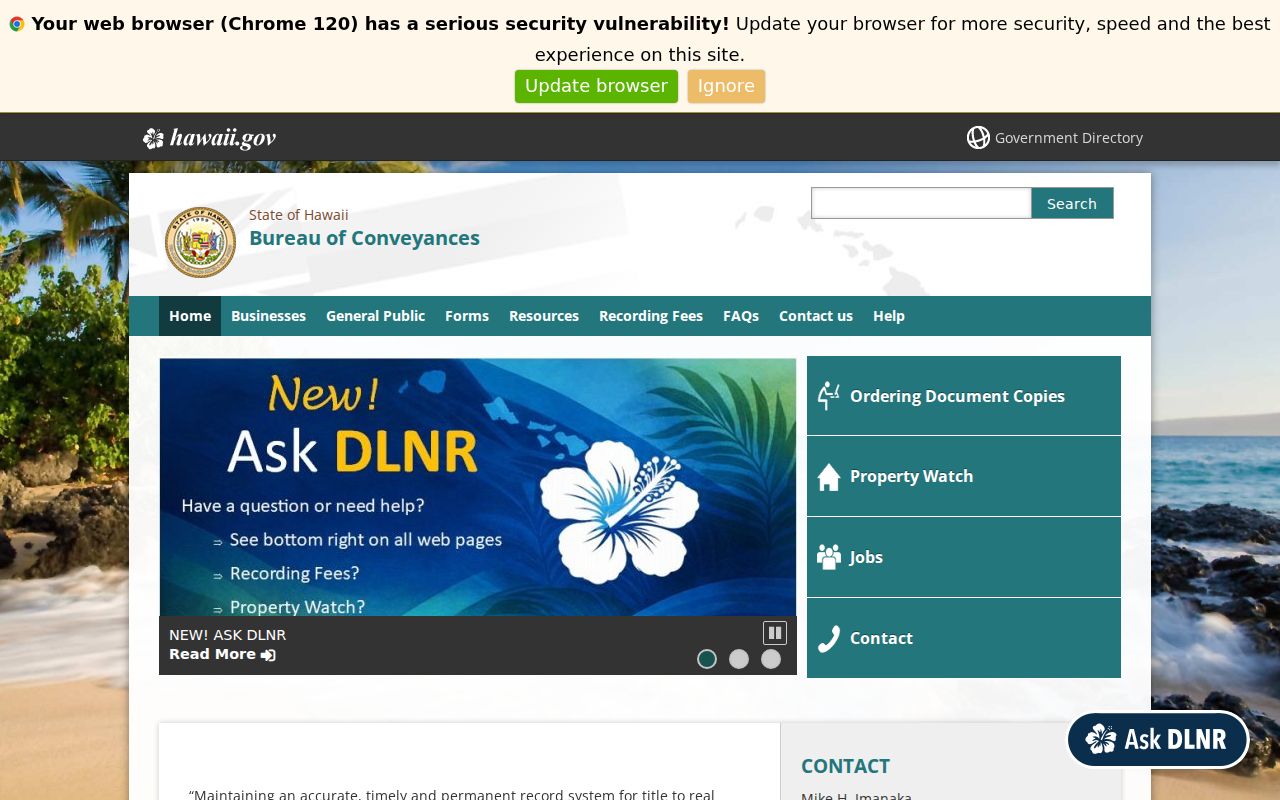
This is the title-record stop in the Hilo residents directory, not proof that a named owner occupied the parcel on any particular date.
Current Hilo Directory-Like Sources
No single current Hilo residents directory lists every household. Official systems organize people by a public role: parcel owner, registered voter, recorded-document party, court party, license holder, business registrant, or person named in legislation. Choose the narrowest system that answers the question and do not merge those roles into a dossier.
| Source | Who It Lists | Keeper | Access |
|---|---|---|---|
| RPT parcel records | Owners of record | County Real Property Tax | Public portal and office |
| Official voter verification | Individual registrants | State and County Elections | Protected-input lookup |
| Recorded document index | Grantors and grantees | Bureau of Conveyances | Account search; copies paid |
| County Council records | People in public civic records | County Clerk | Laserfiche text search |
| Professional licenses | Licensed professionals | DCCA PVL | Public status search |
A name hit remains only a possible match until a date, role, location, Party ID, license number, or source document confirms it. The Hilo resident search walkthrough shows how to verify one person without confusing public roles.
A Hilo Court Name Needs a Docket
eCourt Kokua Person Search requires first and last name and offers middle name, filing-date limits, case type, phonetic searching, and partial searching. Results proceed through a Party ID to Summary, Offenses, Events, and Dockets tabs. Narrow a common name with filing dates and case type, then read the docket and any public PDF. Confidential and sealed items do not appear, and case-type coverage begins at different dates. An empty search can therefore mean no covered online result, not no court history.
When online coverage does not answer the question, Third Circuit Legal Documents in Hilo accepts the official order/request route by mail, fax, or in person. The office lists 808-961-7400 and hilolegaldocs.3cc@courts.hawaii.gov. Name-only searching has a documented fee, and mailed or offsite files can take longer than ordinary requests. A court record proves a procedural role in a particular case; it does not by itself establish present Hilo residence.
Hilo Voter Status Is Public but the Affidavit Is Not
HRS §11-97 and Office of Information Practices guidance separate limited public election fields from the protected registration affidavit. Name, district, precinct, and status may be public in the proper official setting. Social Security fragments, driver-license or state-ID numbers, signatures, and other affidavit details are protected. The official Online Voter Registration Lookup uses private inputs to verify a voter; it is not a public name-and-address directory.
For registration help, County Elections is at 25 Aupuni Street, Room 1502. Good-cause voter-address confidentiality and the separate Hawaiʻi Address Confidentiality Program are important reasons never to treat a hidden address as a missing resident.
Vital Records Require a Hilo Eligibility Check
Hawaiʻi Department of Health certificates are not an open people index. Access turns on the record, the requester’s identity, and a direct or tangible interest under HRS §338-14. Current routes include online ordering with ID upload and payment, mail, and in-person service. Hilo’s Hawaiʻi District Health Office is at 75 Aupuni Street, Suite 201, with Tuesday and Thursday pickup by appointment after online payment. Older genealogy material, generally more than 115 years old, follows a different DOH, library, microfilm, or State Archives path.
The Hilo vital statistics office page is the local service reference.
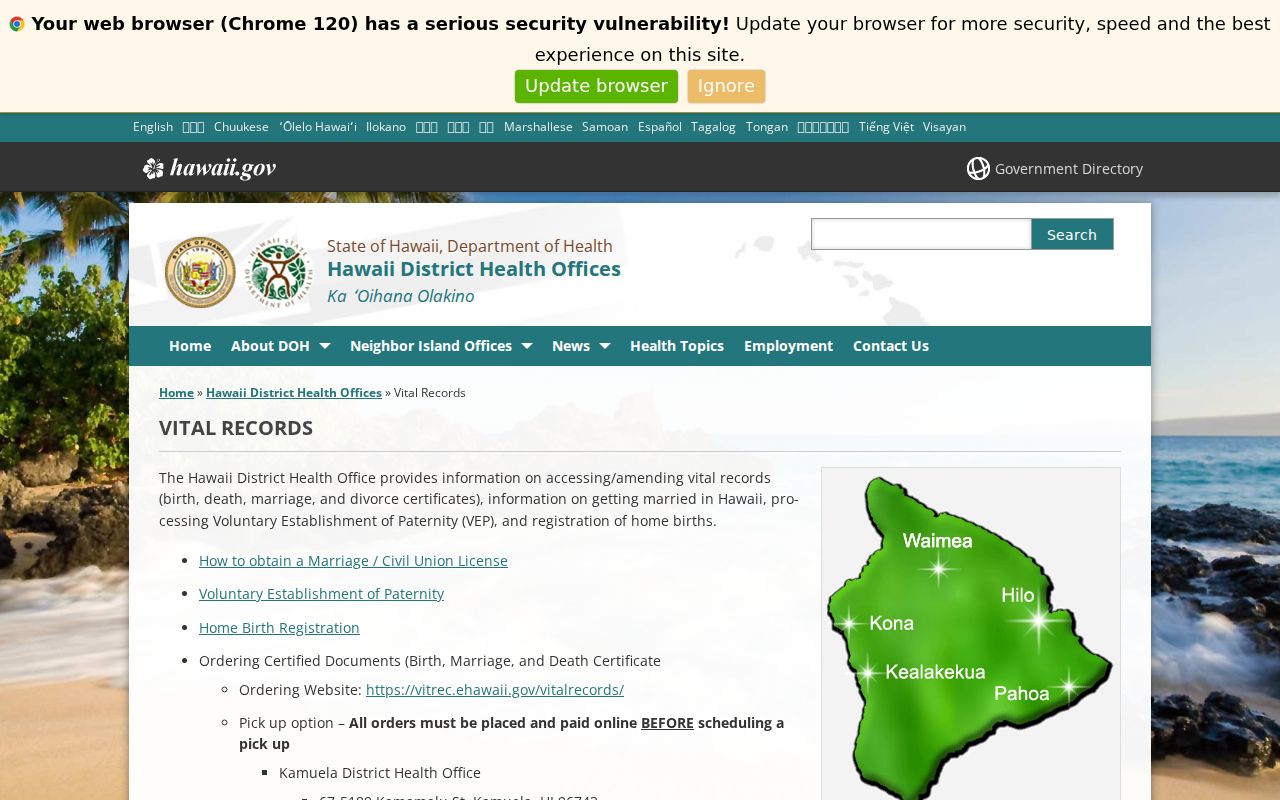
The screenshot captures that local doorway; it should be used to confirm appointment and service details, not as a substitute for entitlement documentation. Since February 1, 2026, DOH no longer maintains divorce records; current divorce-document questions go to Third Circuit Legal Documents.
When a Hilo Records Portal Will Not Open
A blocked portal is a routing problem, not a negative search result. If RPT is unavailable, retain the normalized address and TMK, then contact the Real Property Tax office or Planning. If a BOC login prevents inspection, use the Bureau’s public instructions, reference room, or written request. If eCourt coverage is incomplete, order from Third Circuit. For an old name, ask Mookini Library or the State Archives about call numbers, microfilm, date coverage, reproduction rules, and appointments.
For an identifiable county or state agency record without a dedicated process, Hawaiʻi’s Uniform Information Practices Act is the fallback. The Office of Information Practices request guide says to identify the requester, describe the record specifically, provide contact information, select inspection or copies, and state the delivery method.
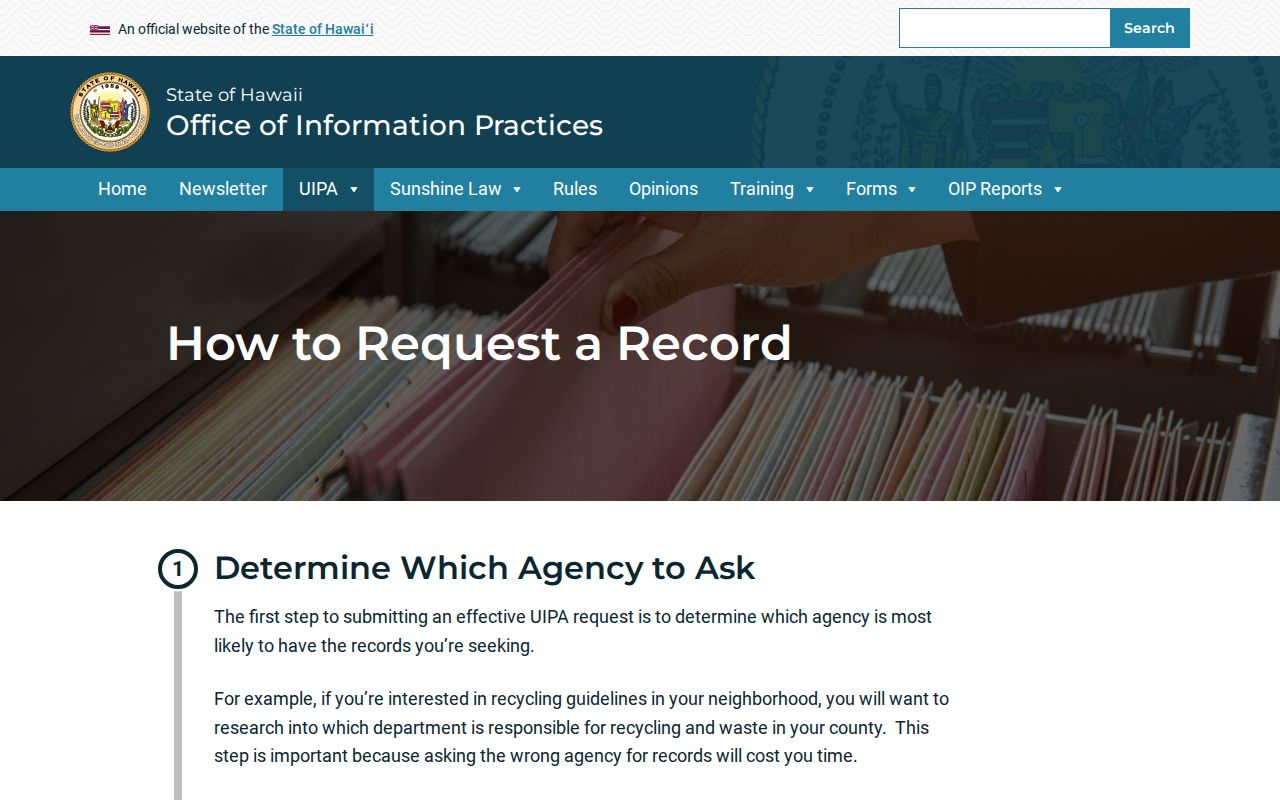
The guide supports a focused request to the agency that actually keeps the record. Agencies generally have ten business days to grant, deny, or acknowledge an extension; clarification or prepayment can affect the response timetable.
What “Hilo” Means in a Residents Directory
Hilo is a Census-designated place and County seat in a state without incorporated municipal governments. A Hilo postal label, Hilo CDP boundary, South Hilo planning reference, tax parcel, and Census ZIP Code Tabulation Area answer different geographic questions. That distinction matters: County Clerk and County departments supply local records, while BOC, Judiciary, DOH, Elections, and Archives remain statewide custodians.
The state government background page documents the County structure.
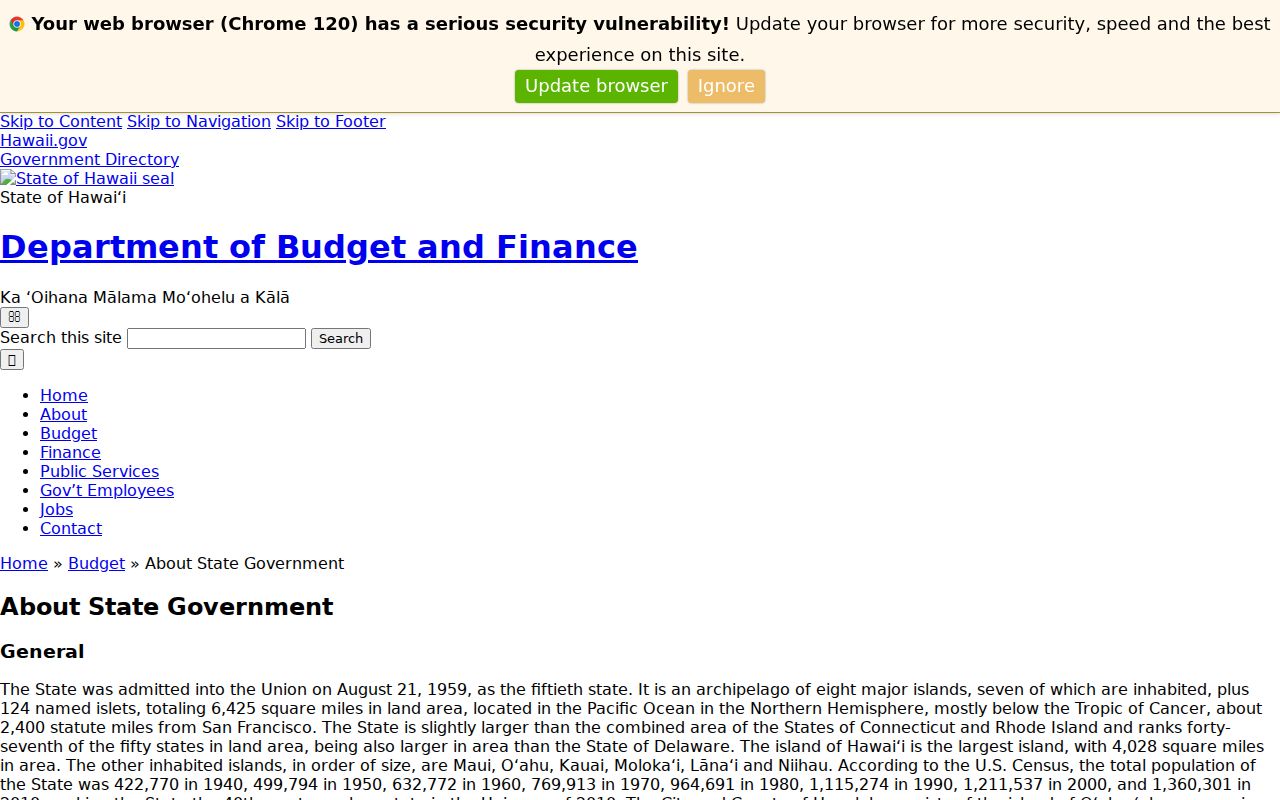
This structure is why a search for a supposed “Hilo city recorder” fails: the correct title-record office is statewide, while assessment and address functions sit with the County.
Use Hilo Public Records With Restraint
Official records can be incomplete, delayed, corrected, sealed, or intentionally protected. Use the least intrusive source that answers a lawful personal question. Do not publish full addresses, identification numbers, signatures, or bulk labels; do not try to defeat the Address Confidentiality Program or voter protections. A commercial people-finder may merge stale sources without showing dates or custodians, while an official record can be cited to an office, document, and checked date. Neither should be used to stalk, harass, threaten, or falsely identify someone.
Evidence language matters. Say “possible match” for a name-only result, “confirmed record” when the source image and identifiers align, and “research gap” when access or coverage cannot be verified. Never convert owner of record, delivery address, case party, or historical directory entry into an unsupported claim of current occupancy.
Trace Hilo Residents Through Dated Collections
Hawaiʻi directory research often means island-wide titles rather than a continuous Hilo-only series. The Polk island series runs from 1954 through 1987 in documented library holdings, and the Hawaiʻi Digital Archives presents a 1965 Islands directory as a 666-image collection. Read the scan itself and cite its publisher, year, page or image, spelling, street, and occupation. A search snippet is not enough, and no Hilo reverse-directory run should be claimed until a reference librarian verifies it.
Mookini Library’s Hawaiian Collection adds its Hilo bibliography, maps, oral histories, newspapers, and microfilm. State Archives collections extend the trail through vital indexes, probate, divorce, passenger, naturalization, census, obituary, map, and photograph material. The full shelf guide is on the Hilo city directory collections page, while the past residents address trail pairs those dated sources with deeds and parcel history.
Hilo’s 36 Library of Congress Sanborn sheets span publications from 1921 through 1957. They can place a structure or business on a block and help reconcile an old street number, but they do not identify a present occupant. Harbor development, plantation-era migration, and the 1946 and 1960 tsunami histories also explain why households and street uses may change sharply between sources. The most reliable Hilo residents directory entry is therefore a dated citation, not a timeless claim.