
Hilo Directory Collections by Year
Hilo does not have a verified, continuous shelf of volumes issued only for the city. The strongest run is Polk's directory of the islands of Hawaiʻi, Maui, and Kauaʻi, including Lānaʻi and Molokaʻi. A University of Hawaiʻi bibliography identifies the series from 1954 through 1987 under call number HAWN DU 621 .P64 and microfiche D70144. The title also appears in catalogs as a city directory of the islands. That island scope matters: a researcher must find the Hilo portion and cite the exact page rather than treat every entry as local.
| Collection | Years | Where Held | Access |
|---|---|---|---|
| Polk island directory series | 1954-1987 | UH collections, HAWN DU 621 .P64; microfiche D70144 | Catalog and repository access |
| Directory of the Islands image set | 1965 | Digital Archives Hawaiʻi | 666 images, open online |
| Hilo historic maps and periodicals | Maps 1914-1957; periodical dates vary | Edwin H. Mookini Library | Catalog, guides, microfilm, and staff help |
| State archive genealogy series | Government records from 1840 onward | Hawaiʻi State Archives | Digital guides and repository research |
The 1965 Directory of the Islands collection is the clearest remote entry point. It contains 666 open images. A 1980 Polk catalog result was also found, but its viewer and permissions were not verified. No official source confirmed a separate Hilo reverse or criss-cross run. Ask a librarian about that format instead of assuming it exists.
The Digital Archives page shows how the island volume is delivered online:
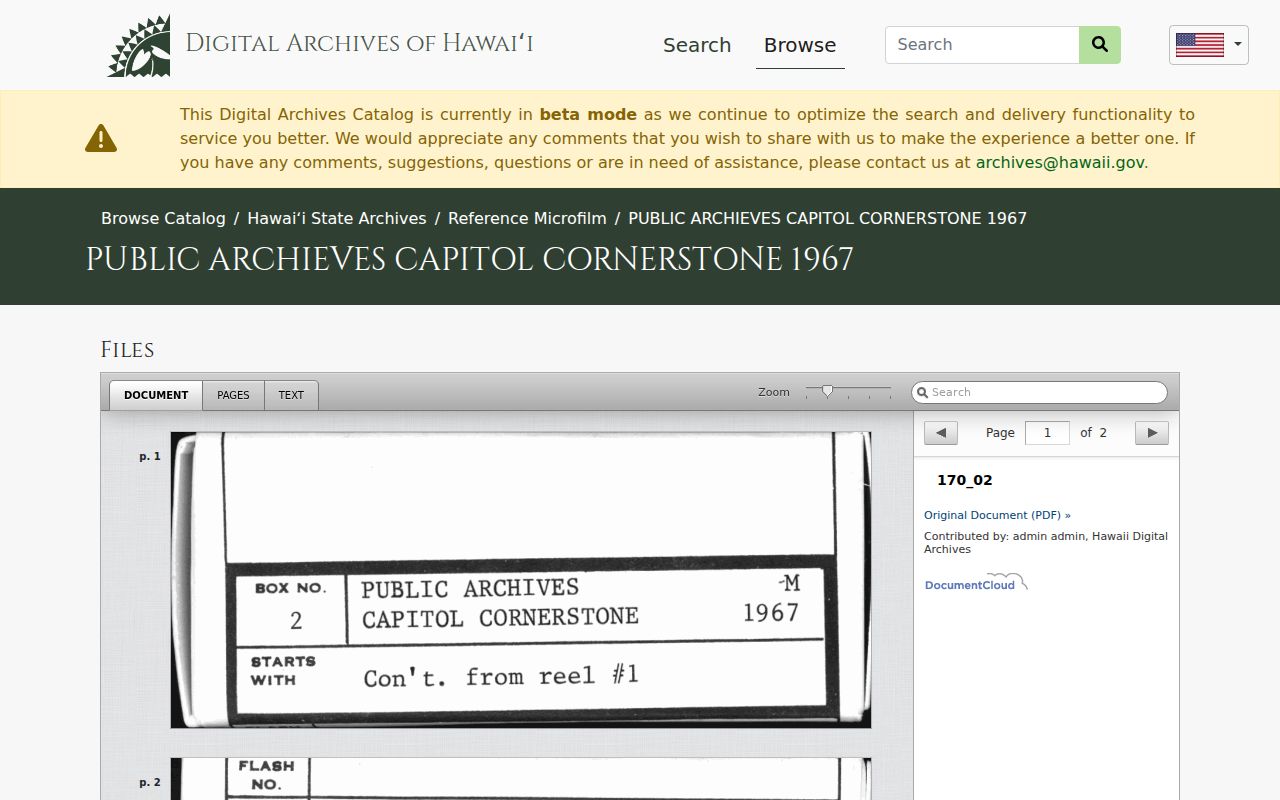
The image set supplies a page-level trail, so record the image number along with the printed page and directory title.
Mookini Opens Hilo History
The Edwin H. Mookini Library is the most useful Hilo contact when a catalog description is not enough. It is at 200 West Kawili Street and can be reached at 808-932-7286 or mookini@hawaii.edu. Its Hawaiian Collection includes books, historic periodicals, microfilm, maps, and HŌKŪ digital material. Microforms are generally used in the library, so confirm hours, access, and reader availability before a visit.
The local bibliography reaches well beyond city directories. It points to oral history from Keaukaha, work on Chinese families and businesses in Hilo, recollections of Banyan Drive, Hilo Bay histories, and accounts of the 1946 and 1960 tsunamis. Those sources give social context to a terse printed line. They can explain why an occupation, firm, or district appears in a given year.
The library directory provides the contact point for that research:
Send the title, year, name variants, and any known page or call number so staff can answer a narrow shelf question.
Reading a Hilo Directory Entry
A Hilo city directory image may place a person, firm, street, and trade on one short line. Yet the exact fields depend on the volume. The inspected 1965 archive is an image set, not a modern database with uniform columns. Transcribe only what is printed. Photograph or save the abbreviation key first, because a single letter may distinguish a residence note from a business listing.
| Printed name | Keep initials, diacritics, and spelling exactly as shown. |
|---|---|
| Work or business | Record an occupation or firm only when the entry states it. |
| Street or place | Copy the full address and any residence marker. |
| Household detail | Note a spouse or relationship only when explicitly printed. |
| Citation | Save title, year, printed page, image number, and repository. |
- Criss-cross directory
- A directory arranged by street or address instead of a person's surname. No verified Hilo run was located.
- Householder index
- A list keyed to a household name, sometimes separate from business or street sections.
- Abbreviation key
- The volume's own legend for shortened terms and symbols. Its meanings control how an entry should be read.
A missing name proves little. The person may have been outside the publisher's coverage, listed under another spelling, represented by a business, or absent from that edition. Mark it as “not found in the checked volume,” not as proof that the person had left Hilo.
Hilo Directory Archive Companions
The Hawaiʻi State Archives adds records that can test a directory match. Its holdings begin with government records from 1840, judiciary material from 1847 to about 1916, about 120,000 photographs, and roughly 1,800 maps. Genealogy guides point to newspaper notices from about 1850 to 1950, vital indexes for 1832-1910 and 1911-1929, probate, divorce, naturalization, passenger, census, and obituary material.
Hilo-specific court series include Third Circuit probate from 1854-1897 and Fourth Circuit files for Hamakua, Hilo, and Puna from 1881-1904. These are not substitutes for an island directory. They answer a different question, such as whether the same name appears in a dated estate or court file. Search by name variants, then cite the series and file rather than merging two records on name alone.
Note: A directory match becomes stronger when a second dated source agrees on the name, place, and period.
Maps Clarify Hilo Directory Addresses
The Library of Congress Hilo Sanborn collection contains 36 sheets published from 1921 through 1957. The maps show streets, building footprints, construction, use, fire risks, and nearby blocks. They do not name current residents. Their value is spatial: a Sanborn sheet can show what stood near a printed address when a city directory was issued.
Photographs provide another check. The Hawaiian Historical Society holds books, manuscripts, newspapers, maps, photos, and broadsides in a noncirculating reading room. Its photo holdings include about 10,000 images and 2,000 negatives; the Kelsey collection is especially relevant to Hilo in the 1920s. Visits are by appointment during the society's posted Thursday, Friday, and Saturday hours.
The society's research page introduces the collection and reading-room route:

A photograph can confirm a storefront or block, but unidentified people in an image should remain unidentified.
Trace Families in Hilo Directories
Treat each Hilo city directory as a dated snapshot. Start with the most certain name and year, preserve spelling variants, and move one volume at a time. Census, newspaper, probate, and vital indexes can bridge long gaps, while maps help reconcile an address. The aim is a chain of cited facts, not a blended profile.
- Find the first likely entry in a dated island directory and save its full citation.
- Check the prior and next available editions for a move, spelling change, trade, or business link.
- Compare a census year or surviving Hawaiʻi enumeration with the same name and place.
- Use a newspaper, probate, obituary, or vital index to test family and event details.
- Map the address with Sanborn or County sources, keeping historical and present records separate.
Disappearance from a run has several possible causes. The household may have moved, the publisher may have missed it, the person may be listed under another form of the name, or the relevant Hilo pages may be absent. An obituary or probate file can support a death; a later directory or deed may support a move. Without that second source, record only the gap.
Hilo Names Need Island Context
A common myth is that a historical city directory works like a live resident search. Hilo's key publications span several islands, and each entry belongs to the edition's date. A printed street does not establish a present home. A trade does not prove the same role in another year. Even a rare name needs a second fact before two entries can be joined.
For family history, the island format can be an advantage. It may reveal a move between communities or a business with several locations. Preserve place labels exactly and check whether “Hilo” means the district, a postal label, or the city-designated place in that source. Hawaiʻi has no separate incorporated-city government, so many confirming records sit with the County of Hawaiʻi or a state office.
Access also changes with the keeper. Digital Archives offers a remote image set. Mookini supplies local reference help, maps, microfilm, and licensed news sources. The State Archives provides online finding aids and older records, while many original series still require a focused repository request. The Hawaiian Historical Society uses a noncirculating reading room by appointment. Email or call before traveling, and give the title, year, name, page, or collection series. Reproduction rules and fees should be confirmed with the repository.
A useful working timeline begins with archive and court material in the nineteenth century, continues through Sanborn mapping from the early to mid-twentieth century, and reaches the verified Polk island run from 1954 to 1987. The 1965 image set supplies a fully cited midpoint. This is not a claim that every Hilo year survives. It is a map of verified access points. If a year is absent, newspapers, census microfilm, probate, photographs, or maps may supply context, but each source should keep its own date and meaning.
Research tip. Ask repositories for the exact title, edition, Hilo page span, access rules, and reproduction cost before planning a visit.